Summary
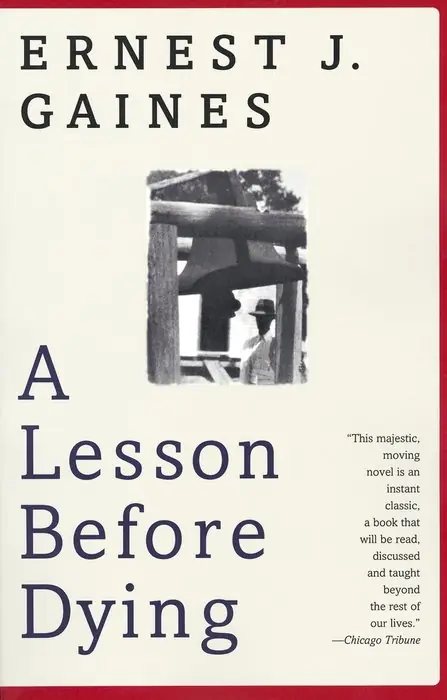
Bayonne, Louisiana, 1948. Jefferson, a young Black man, is in a liquor store when a robbery goes wrong and the white owner and two Black men are shot dead. He alone walks out, and the court convicts him of murder. His own lawyer, arguing for his life, tells the jury he would as soon put a hog in the electric chair. That word is what his godmother, Miss Emma, cannot bear. She and her friend Tante Lou press Tante Lou's nephew Grant Wiggins, the teacher at the plantation school and the only college educated Black man in the quarter, to visit Jefferson in the parish jail and teach him to die like a man. Grant, who narrates, wants no part of it. He is bitter about the school, about the deference he has to show Henri Pichot and Sheriff Guidry to get permission, about a South he would leave tomorrow if Vivian, the married teacher he loves, would come with him.
The visits are the book. Jefferson at first will barely speak; Grant keeps coming; Reverend Ambrose comes too, worried that Grant is teaching the boy pride rather than God. Grant borrows the money for a radio, the schoolchildren bring gifts, and he gives Jefferson a notebook, in which Jefferson begins, in his own spelling, to write down what he thinks. Kirkus described that notebook as something like a miracle, water from the rock. The execution is set for April 8. Grant cannot make himself attend. Waiting outside his schoolroom in the church, he watches a butterfly settle on a sprig of bull grass and fly off out of sight, and feels that it is over. Then the young white deputy, Paul Bonin, who has come to respect him, drives up and tells him that Jefferson was the strongest man in that crowded room.
Gaines writes in short, plain sentences with almost no raised voice, and the restraint is the point: Publishers Weekly called the narrative restrained but eloquent, and Kirkus said it is never maudlin and approaches the spare beauty of a classic. It is about 250 pages and reads in a couple of sittings, and it suits readers of To Kill a Mockingbird who want the same period told from inside the quarter.
Historical Context & Significance
A Lesson Before Dying won the National Book Critics Circle Award for Fiction for 1993, presented the following year, over E. Annie Proulx's The Shipping News, Bobbie Ann Mason's Feather Crowns, Frances Sherwood's Vindication, and Rikki Ducornet's The Jade Cabinet; the Pulitzer Prize for 1994 went the other way, to Proulx. Gaines drew Bayonne and its plantation quarter from his own childhood on Riverlake Plantation in Pointe Coupee Parish, and the novel is set in a small Cajun community in the Jim Crow South of the late 1940s. Publishers Weekly called it his crowning achievement.
The book's second life began when Oprah Winfrey chose it for her book club in October 1997. HBO's film followed in May 1999, with Don Cheadle as Grant, Mekhi Phifer as Jefferson, and Cicely Tyson as Tante Lou, from a script by Ann Peacock; it won Emmys for outstanding television movie and for its writing, and a Peabody Award. Romulus Linney's stage version opened at the Alabama Shakespeare Festival in January 2000 and moved off Broadway that September. Kirkus called it Gaines's most powerful and moving work since The Autobiography of Miss Jane Pittman.
Where to get it
We may earn a commission if you buy through these links, at no extra cost to you.
Opens WorldCat, a catalogue of library holdings run by the nonprofit OCLC. We do not ask for or receive your location.