Summary
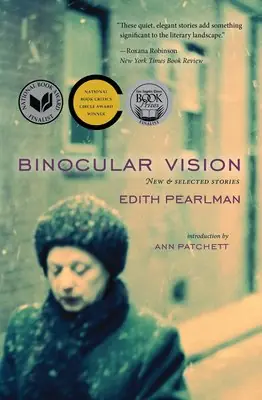
Binocular Vision gathers thirty four stories by Edith Pearlman, twenty one chosen from her three earlier collections and thirteen new, and it was published in January 2011 by Lookout Books, a small press at the University of North Carolina Wilmington. Pearlman was seventy four. Ann Patchett opens her introduction by asking why Edith Pearlman is not famous, and puts the question alongside how the pyramids were built and why anyone uses Styrofoam. The stories range across New England, Latin America, Europe, Israel and Russia, and many of them concern people who have been displaced, from Jewish refugees out of wartime Europe to characters who simply do not feel at home in their own skins.
A few give the flavor. In the title story a ten year old girl watches the couple next door through their windows and builds a false account of their marriage from what she sees. In "Day of Awe" a Boston retiree visits an orphanage in Central America. In "ToyFolk" an American couple in Central Europe find a house full of toys and no child. "Allog" follows an apartment building in Israel whose residents have to think about who counts as an outsider when one of them hires an Asian immigrant. "Granski" has a grandmother pull two privileged teenage cousins back from recklessness. "The Noncombatant" is set on the home front in the Second World War, where Richard, a doctor of forty nine, has cancer, and "Self-Reliance" gives a retired gastroenterologist named Cornelia Fitch, her cancer returned, a moment of grace beside a wooded pond. Several stories, among them "Rules," set at a soup kitchen, take place in Godolphin, a fictional Massachusetts town Pearlman returns to often.
Pearlman writes short, exact, unshowy sentences, and the stories are compact enough to read one at a time over weeks, which is how most people end up reading her. Kirkus called the book "another virtuoso performance from a writer who does indeed deserve to be better known," and Publishers Weekly said it "should win new converts for Pearlman." It suits readers of Alice Munro and William Trevor who want a writer they have not yet met, and anyone who prefers a collection they can dip into rather than a novel to be finished.
Historical Context & Significance
Binocular Vision won the National Book Critics Circle Award for Fiction for 2011, announced on March 8, 2012 at the New School in New York. The finalists it beat were Teju Cole's Open City, Jeffrey Eugenides's The Marriage Plot, Alan Hollinghurst's The Stranger's Child and Dana Spiotta's Stone Arabia, which made a small press book an unusual winner. The same collection was a finalist for the 2011 National Book Award, which went to Jesmyn Ward's Salvage the Bones, and a finalist for the Story Prize, won that year by Steven Millhauser's We Others. In 2011 Pearlman also received the PEN/Malamud Award for the short story and the Edward Lewis Wallant Award.
Pearlman, born in Providence, Rhode Island, in 1936 and a Radcliffe graduate, had published Vaquita and Other Stories (1996, winner of the Drue Heinz Literature Prize), Love Among the Greats (2002) and How to Fall (2005) before this book. The prizes brought her a mainstream publisher at last: Honeydew followed from Little, Brown, and Pushkin Press issued Binocular Vision in Britain in 2013. She died in Brookline, Massachusetts, on January 1, 2023, aged eighty six.
Where to get it
We may earn a commission if you buy through these links, at no extra cost to you.
Opens WorldCat, a catalogue of library holdings run by the nonprofit OCLC. We do not ask for or receive your location.