Summary
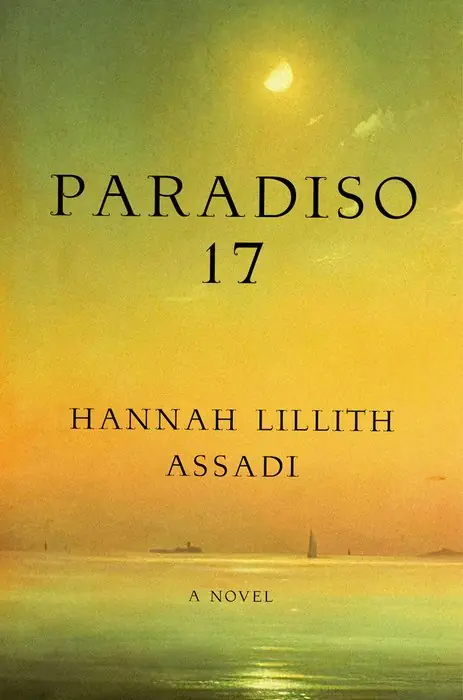
Sufien is five in the spring of 1948 when the Nakba drives his family out of Safad, away from the house on the hill with the blue door. Paradiso 17 follows him from that loss to his deathbed in his seventies, where he lies dying of cancer and remembers. The family goes first to a refugee camp in Syria and then to Kuwait, where his father gets an engineering job and Sufien falls for Nefisa, a girl who is a refugee like him. At 17 he leaves to study in Italy, until the money for tuition runs out. There he falls in love with a woman named Lila and meets Bernardo, a rich Jewish American who becomes his best friend for life. Bernardo coaxes him to New York, where Sufien works in a bodega, drives a taxi and marries Sarah, a Jewish woman from a comfortable family. When he goes bankrupt they move to Arizona, raise a daughter, Layla, and the desert becomes the nearest thing he has to home. The title joins Dante's canto of exile, the seventeenth of the Paradiso, to the number on the door of the stolen house, which follows him everywhere.
Assadi based Sufien on her late father, and the novel does not make a saint of him. He is charming, funny and spiritual, and prone to melancholy. He drinks too much, cheats, takes out loans he shouldn't, starts businesses that fail, and turns again and again to Bernardo, Sarah and her father to rescue him. Eman Quotah, in The Markaz Review, put it plainly: he is "no perfect victim."
The book begins at the end and circles back, and each chapter's title is also its final line, so every episode closes on a return. The prose is dreamy, the book is full of Sufi myths, prophetic dreams and visions of the afterlife, and Kirkus found it sometimes over the top. Kirkus also noted that Sufien's charm fades as he ages, and that his family, his friends and the reader never stop loving him. It suits readers who want a whole life rather than a tight plot, and anyone who has watched a parent carry a lost country through decades of exile.
Historical Context & Significance
Paradiso 17 won the 2026 National Book Award for Fiction, announced on Wednesday, November 18, 2026, at Cipriani Wall Street in New York, for a novel Hannah Lillith Assadi based on the life of her late father and began writing as he lay dying. In her acceptance speech she spoke of the book's journey "from its origins at my father's deathbed until now." The judges called it "a visionary, finely wrought portrait of rupture and endurance." Caro De Robertis chaired the judges, Matt Bell, Danielle King, Akhil Sharma and Diane Wilson, who chose it over Edwidge Danticat's Dèy, Julián Delgado Lopera's Pretend You're Dead and I Carry You, Valeria Luiselli's Beginning Middle End and Morgan Thomas's Mad Eden. Publishers had submitted 451 books for the fiction award, which carried $10,000, a bronze medal and a statue.
Knopf published it on March 17, 2026, and it was longlisted for the 2026 Women's Prize for Fiction. Kirkus wrote that "with a generous vision, Assadi has created an unforgettable character in a multidimensional world." Rabih Alameddine and Omar El Akkad, the previous year's National Book Award winners for fiction and nonfiction, both praised it. It is her third novel. Her first, Sonora, won the Rosenthal Family Foundation Award from the American Academy of Arts and Letters and was a finalist for the PEN/Robert W. Bingham Prize, and in 2018 the National Book Foundation named her one of its 5 Under 35. She teaches fiction at Columbia University School of the Arts and Pratt Institute.
Where to get it
We may earn a commission if you buy through these links, at no extra cost to you.
Opens WorldCat, a catalog of library holdings run by the nonprofit OCLC. We do not ask for or receive your location.