Summary
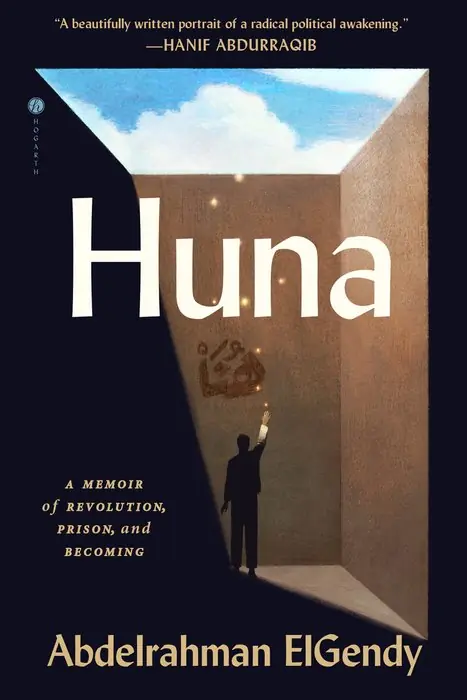
In 2013, two years after the January 25 revolution, Abdelrahman ElGendy was a 17 year old student in Cairo, newly drawn into the protests that followed that summer's military coup. On October 6, 2013, he was filming a demonstration from the family car, his father at the wheel, when police arrested them both. Huna: A Memoir of Revolution, Prison, and Becoming is his account of what followed: a mass trial, a sentence of 15 years, and more than six years in which he was moved, much of the time alongside his father, from a holding cell to pretrial detention to the Scorpion, Egypt's most notorious prison complex. In a crowded holding cell he first heard the Arab world's most enduring protest song, "Sawfa Nabqa Huna," We Will Remain Here, and began to wonder, if no one wanted to stay behind bars, what "here" they were choosing to inhabit. His father was released first. ElGendy came out in January 2020, and the book follows him into exile, ending with his departure from the United States in the spring of 2025, after the ICE detention of Mahmoud Khalil.
Inside, he earned an engineering degree, taught English and Arabic to other prisoners, and wrote, smuggling pages out during family visits. The prison he describes is a society: inmates share food, run classes and stage musicals and poetry slams, while rival ideological camps feud. At its heart are two relationships, with Ayman, the friend who kept him laughing, and with his father, Baba, who had gone to the demonstration to keep him safe, a bond in which love and guilt sit side by side.
ElGendy writes in English but refuses to make Arabic easy, leaving much of it untranslated, and he includes his letters from prison as he wrote them. When the violence peaks his prose breaks into fragments and poetry, a deliberate choice. It is not a primer on Egyptian politics, and readers who want the history explained will have to look elsewhere. Readers willing to take it on its own terms will find a prison memoir of unusual tenderness, and anger.
Historical Context & Significance
Huna won the 2026 National Book Award for Nonfiction, announced on Wednesday, November 18, 2026, at Cipriani Wall Street in New York, and it is Abdelrahman ElGendy's debut. He could not be there: the United States had refused him a visa to travel from Europe, so his editor at Hogarth, Helen Thomaides, accepted the award and read his speech, in which he recalled dreaming in prison of one day writing a memoir. The judges called the book "a phenomenal liberation story that resists all forces of authoritarian silencing and erasure." Robert Warrior, who announced the winner, chaired the judges, Eve L. Ewing, Audrey I-Wei Huang, Jonathan C. Slaght and Lidia Yuknavitch, who chose it over Colin Asher's The Midnight Special, Camonghne Felix's Let the Poets Govern, Sara Nović's Mother Tongue and Joseph Osmundson's Spawning Season. Publishers had submitted 727 books for the nonfiction award, which carried $10,000, a bronze medal and a statue.
Hogarth published it on September 1, 2026. Kirkus gave it a starred review, calling it "fearless and elegant," and in the Los Angeles Review of Books the novelist Hannah Lillith Assadi, who won the fiction award the same night, called it a remarkable debut. The book began in prison: his smuggled essays found readers online, and then the independent Egyptian outlet Mada Masr published his prison writing. In 2022 he moved to the United States for an MFA at the University of Pittsburgh. He has won the Samir Kassir Award for Freedom of the Press.
Where to get it
We may earn a commission if you buy through these links, at no extra cost to you.
Opens WorldCat, a catalog of library holdings run by the nonprofit OCLC. We do not ask for or receive your location.